
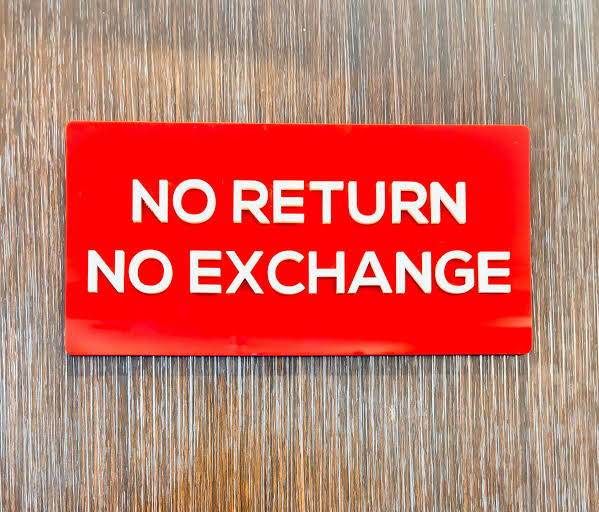
No Refund, No Exchange: Is Your Business Policy Legally Enforceable?
By Onome Ibrahim
When you look up, at the bio of an online vendor or walk into almost any shop in Lagos, Abuja or Port Harcourt and you mostly find a small sign near the till that reads something like No Refund After Payment or Goods Once Sold Cannot Be Returned. Many business owners treat this sign as gospel truth, a shield that protects them from every complaint a customer might raise. Many customers, on the other hand, simply accept it because they assume the shop owner knows the law better than they do.
The truth that might surprise both sides is that in Nigeria, a no refund , no exchange policy is not automatically valid simply because it is written on a receipt or pasted on a wall. Nigerian law, through the Federal Competition and Consumer Protection Act 2018, actually limits how far such policies can go. Let us walk through what the law really says, and what this means for your business.
The Law Behind the Sign
Before 2019, Nigeria relied on the older Consumer Protection Council Act, which was fairly limited in scope. That changed when the Federal Competition and Consumer Protection Act 2018 (FCCPA) was signed into law, creating the Federal Competition and Consumer Protection Commission (FCCPC) as the body responsible for enforcing consumer rights across the country.
The FCCPA gives consumers a set of clear rights, including the right to choose or examine goods before buying them, the right to receive goods that meet acceptable quality standards, and the right to return goods in specific circumstances. Section 130 of the Act is particularly important here. It provides that where a supplier knows the purpose for which a consumer wants to use a product, and the product turns out to be unsuitable for that purpose or does not match the description given, the consumer is entitled to a full refund.
In simple terms, if you sell someone a phone charger and tell them it works with their specific device, but it does not, the law says they can bring it back and get their money returned, regardless of any sign at your counter.
What the Courts Have Said
Nigerian courts have already tested this issue, and the results have not been kind to sweeping the no refund clauses.
In Patrick Chukwuma v Peace Mass Transit Limited, a passenger who cancelled his trip after a two hour delay was refused a refund by the transport company, which relied on its no refund after payment policy.The Enugu State High Court ruled that this policy could not override the consumer’s right to a refund where the service itself had failed to meet a reasonable standard, and the company was ordered to pay damages.
A similar outcome followed in Edem Ewa Ekeng and Another v Wakanow.com Limited, where the Lagos State Magistrates Court held that a travel company’s no refund policy could not be used to justify its failure to secure air tickets for a rescheduled flight. The court described the policy as illegal, null and void, and ordered a full refund alongside damages.
Even earlier, long before the FCCPA existed, the Supreme Court had already established the underlying principle in Nigerian Bottling Company Ltd v Ngonadi, where a woman was injured by an exploding refrigerator she had purchased for her business.The court confirmed that manufacturers and sellers owe consumers a duty of care, and that liability cannot simply be waved away by a disclaimer.
Taken together, these decisions send one clear message. A sign at your counter is not a shield against the law. It is, at best, a house rule, and house rules bow to statute.
When Can a No Refund Policy Actually Work?
This does not mean every return request must be honoured, or that businesses have no room to set reasonable terms. The law draws a line between refusing a refund out of pure inconvenience and refusing one where the product or service genuinely failed the consumer.
A no refund policy tends to hold up where goods are custom made to a customer’s specification, where the customer simply changed their mind after examining and accepting the goods, or where perishable or time sensitive items are involved and clearly labelled as such at the point of sale. In these situations, businesses are on firmer ground, provided the terms were made clear before payment, not slipped in afterward on a receipt the customer never saw.
Regulators have also begun paying closer attention to this. The FCCPC has publicly warned traders, including those in major markets against posting blanket no return no refund signs without regard to the law, signalling that enforcement is not merely theoretical.
What This Means for Your Business
If your business currently relies on a no refund no exchange sign as a catch all defence, it may be time for a rethink. A few practical steps can help you stay on the right side of the law while still protecting your business from abuse of genuine return policies.
Write your policy in plain language and make sure customers see it before they pay, not after. Distinguish clearly between defective or misdescribed goods, which the law requires you to refund or replace, and simple change of mind purchases, where you have more room to set your own terms. Train your staff to understand this distinction so a customer with a legitimate complaint is not turned away at the door. Then, where a dispute arises, resolve it early, since the cost of a court judgment and reputational damage almost always outweighs the cost of an honest refund.
Lastly,a no refund no exchange sign might feel like protection, but under Nigerian law it is only as strong as the fairness behind it. Businesses that build their policies around the FCCPA, rather than around a hopeful assumption that customers will not push back, tend to avoid the costly surprises that come with a courtroom loss. Treat your refund policy as a tool for clarity and trust, not a wall to hide behind, and you will likely find it serves your business far better in the long run.
References
- Consumer Protection Council Act, Cap C25, Laws of the Federation of Nigeria 2004 (repealed).
- Federal Competition and Consumer Protection Act 2018, Federal Republic of Nigeria Official Gazette No 18, Vol 106
- Patrick Chukwuma v Peace Mass Transit Ltd (Enugu State High Court, 2021, unreported).
- Edem Ewa Ekeng and Another v Wakanow.com Ltd, Suit No SCC/LAG/184/2022 (Magistrates Court of Lagos State, October 2022, unreported).
- Nigerian Bottling Co Ltd v Ngonadi (1985) 1 NWLR (Pt 4) 739 (SC).
- FCCPC Warns Lagos Traders Against No Return, No Refund Policy’ Vanguard (Lagos, 4 March 2026).